https://www.thereviewshub.com/opera-norths-the-greek-passion-leeds-grand-theatre-leeds/
Blog
Another good review. Bachtrack
https://bachtrack.com/review-martinu-greek-passion-alden-spence-opera-north-leeds-september-2019
Review of Greek Passion From The Guardian.
https://www.theguardian.com/music/2019/sep/16/the-greek-passion-review-martinu-grand-theatre-leeds
Review of Greek Passion from The Stage
huslav Martinu’s The Greek Passion may be more than 60 years old, but its contemporary relevance is stinging.
The Czech composer’s opera, presented by Opera North in its original 1957 version, tells the story of a group of refugees who flee to a Greek island where the villagers are performing a Passion Play for Easter. They face a hostile reception, but when the performers begin to take on aspects of their characters, passions are inflamed.
Charles Edwards’ set is both minimal and imposing, consisting of a huge bench-like steps structure, but it’s the representation of the refugees that really impresses. The Opera North chorus plays the roles of both the locals and the newcomers, holding stark white mannequins in their arms to give them a voice. When a refugee dies, the figure is hoisted up to the sky and the effect is eerie and unsettling.
Christopher Alden’s production makes some modern additions to Martinu’s music – there are touches of polka and folk to be heard, as well as a knee-slapping wedding
song with its own synchronised dance routine. It’s also necessarily dark. Nicky Spence is a tormented figure as Manolios, the ordinary villager struggling to be worthy to play Christ, while Magdalena Molendowska’s affecting soprano brings out the pain in her portrayal of the widow Katerina.
There are some updates to the text too – an exclamation of “bloody vegans!” receives the biggest laugh of the night. Yet this remains an opera with a message – the phrase “give us more of what you have too much of” hangs over the stage towards the end of both halves. Opera North has produced an accessible and powerful production that hits home hard.
Review of Greek Passion in the Sunday Times
Opera review: The Greek Passion, Opera North; Don Giovanni and Werther, Royal Opera
Martinu’s patchy Passion gets a powerful Opera North treatment
Holding pattern: the Opera North chorus in Martinu’s The Greek Passion
TRISTRAM KENTON
The Sunday Times, September 22 2019, 12:01am
In typically adventurous style, Opera North opened its 2019-20 season with a regional touring production of Bohuslav Martinu’s operatic swan song, The Greek Passion, based on Nikos Kazantzakis’s epic novel Christ Recrucified. This opera was famously rejected in 1957 by a subcommittee of the Covent Garden Opera Company, much to the consternation of its then music director, the great Czech conductor in exile Rafael Kubelik.
Kubelik clearly had an empathy not only with his compatriot’s score, but also with the subject matter: at Eastertide, village elders in Lycovrissi, Greece (under Ottoman rule in the novel), choose members of the community for leading roles in the annual Passion play. Their spokesman, the priest Grigoris, warns of the influx of a tribe of refugees seeking asylum from their Turkish oppressors. As the villagers take on characteristics of the parts they are playing, the shepherd Manolios, representing Christ, preaches charity and compassion towards the incomers. Grigoris denounces him as an apostate and incites the Judas character, Panait, to murder him. The refugees, realising they have lost their champion, move on.
Hugh Canning
It’s a powerful narrative, certainly, packed with interesting characters and biblical analogies — the widow Katerina, chosen to play Mary Magdalene and pursued by Panait/Judas, is physically attracted to Manolios — and it is splendidly performed in Leeds, conducted by Opera North’s music-director elect, Garry Walker, and simply staged by Christopher Alden, with enough political resonance to suggest analogies with our own time.
If there is a problem, as in 1957, it is with Martinu’s large-scale yet rarely unforgettable score. The prolific composer, adept in every genre, clearly struggled to find a distinctive “voice” in this cosmopolitan work, set to his own English libretto. For much of the evening, thanks to the heroic and touching central performance of Nicky Spence as Manolios, I thought fondly of Britten’s Peter Grimes, written a good decade earlier, but now a standard repertory piece, while The Greek Passion still hovers on the fringes.
Even so, this is one of ON’s great company shows, featuring a supporting cast that includes stalwart regulars such as Paul Nilon (Yannakos, the pedlar who plans to rob the refugees), Jeffrey Lloyd-Roberts (Panait), Stephen Gadd (Grigoris) and John Savournin (the priest Fotis, the leader of the refugees). Magdalena Molendowska sings clear English words as a big-voiced Katerina. The chorus are so good, one wishes they had better music to sing.
Review of Greek Passion in The Daily Telegraph.
› Culture › Opera › What to See
The Greek Passion, Opera North, review: is Martinu's final masterpiece the most moving opera of our time?
Nicky Spence as Manolios in Opera North's The Greek Passion, its first British staging in 20 years CREDIT: TRISTRAM KENTON
Follow
By John Allison
22 SEPTEMBER 2019 • 4:34PM
https://www.telegraph.co.uk/opera/what-to-see/greek-passion-opera-north-review-martinus-final-masterpiece/ 1/4
23/09/2019 The Greek Passion, Opera North, review: is Martinu's final masterpiece the most moving opera of our time?
From hard hearts to deaf ears, The Greek Passion has never enjoyed an easy reception. Originally commissioned by Covent Garden in the late 1950s, it was rejected then — tensions over Cyprus may have played their part — and has made only sporadic appearances in Britain since. Yet Opera North's new staging, the first in this country in 20 years, shows how Bohuslav Martinu's final operatic masterpiece is perhaps the most moving and topical opera of our time.
Based on Nikos Kazantzakis's 1954 novel Christ Recrucified, its subject is exile, and all the elements of Martinu's own scattered life and diverse stylistic experimentation come together in the piece. That is especially true when Ales Brezina's reconstruction of Martinu's original score is used, as at Opera North, rather than the heavily reworked version that premiered after the composer's death in 1959.
There is no contradiction between its intricate dramaturgy and simple honesty, at least not when they are reconciled so sensitively by the director Christopher Alden and conductor Garry Walker. Alden's production is timeless, yet a few details pin it to the recent past. A serenading shepherd's pipe becomes a cassette player, and Yannakos's donkey is a bicycle — we are no longer in the Greek village of Lycovrissi, as some gratuitous alterations to the libretto (prawn cocktail crisps, anyone?) confirm.
Nicky Spence as Manolios, Rhodri Prys Jones as Michelis, Paul Nilon as Yannakos and Richard Mosley-Evans as Kostandis CREDIT: TRISTRAM KENTON
Playing down the political aspect by not making connections with the current refugee crisis, the production plays up the religious element and — with it — the church's hypocrisy. The two intersect in the chorus's powerful, angry Kyrie Eleison at the end of Act 2.
Charles Edwards's set is dominated by movable raked seating, representing perhaps the refugees' mountain slope, a Greek theatre or simply an abstract frame. The black-clad
https://www.telegraph.co.uk/opera/what-to-see/greek-passion-opera-north-review-martinus-final-masterpiece/ 2/4
23/09/2019 The Greek Passion, Opera North, review: is Martinu's final masterpiece the most moving opera of our time?
chorus carries white plaster effigies, standing for refugees deprived of a voice, and the motto "give us what you have too much of " becomes a feature of the design.
Jeffrey Lloyd-Roberts as Panait, Paul Nilon as Yannakos, Magdalena Molendowska as Katerina, Nicky Spence as Manolios, Richard Mosley-Evans as Kostandis and Rhodri Prys Jones as Michelis CREDIT: TRISTRAM KENTON
Such simplicity allows the music speak for itself. Walker, in his first production since being named Opera North's music director designate, holds the potentially stark and sprawling score together tautly, bringing out Martinu's trademark radiance.
The excellent cast is led by Nicky Spence's Manolios, a real outsider whose generous, unforced tenor conveys the sincerity of the shepherd chosen for the role of Christ in the passion play. As Katerina, the village Mary Magdalene, the soprano Magdalena Molendowska sings with glowing lyricism. Among many others, Paul Nilon's Yannakos and Jeffrey Lloyd-Roberts's biker Panait stand out. The two rival priests contrast strongly, John Savournin as the refugees' leader Fotis, and Stephen Gadd as Grigoris, the lupine defender of the status quo.
Until November 16, in Leeds, Newcastle, Nottingham and Salford. Tickets: operanorth.co.uk (http://www.operanorth.co.uk/)
Contact us
About us (https://corporate.telegraph.co.uk/) Rewards
Archive (https://www.telegraph.co.uk/archive/) Reader Prints (http://telegraph.newsprints.co.uk/) Branded Content
Opera North announces new musical leadership
PUBLISHED ON JUNE 24, 2019
We are delighted to announce two significant appointments to our artistic and musical leadership with immediate effect, marking an exciting renewal in Opera North’s life and future.
Garry Walker becomes Music Director designate and will take up his post from the 2020/21 season in August 2020. As Music Director, Garry will head the musical leadership of Opera North and joins the artistic management alongside General Director, Richard Mantle, and Director of Planning, Christine Jane Chibnall.
Garry Walker, Opera North's Music Director designate © Jack Liebeck
Garry is currently Chief Conductor of the Staatsorchester Rheinische Philharmonie in Koblenz where he will retain some responsibilities until the 2021/2022 season and therefore there will be a period of transition between the two organisations. Once he is in post, he will conduct two opera productions and several symphonic concerts during each season and will become embedded in the life of the company at all levels and across the diversity of the Company’s work.
Garry’s recent work for Opera North has included an impressive and powerful Billy Budd and the double bill Gianni Schicchi & The Rite of Spring. He is due to open Opera North’s upcoming mainstage season in September 2019, with a new production of Martinů’s The Greek Passion.
As Principal Guest Conductor, Antony Hermus, who who made a revelatory debut conducting Opera North’s production of Tosca in 2018, will build on this strong relationship, contributing to the artistic vision of the company and conducting one opera production each season as well as symphonic concerts, whilst retaining his current position as Principal Guest of the North Netherlands Orchestra and continuing his burgeoning international career. Antony is scheduled to conduct The Marriage of Figaro in the 2019/20 season.
Antony Hermus, Opera North's Principal Guest Conductor
Richard Mantle, General Director, Opera North, said:
“I am delighted to welcome Garry Walker to Opera North as Music Director, following a two year recruitment process for this key artistic leadership role. He will be a great colleague and will bring clear, resilient and mindful leadership, driving and inspiring high musical standards as well as being fully alive to our ethos and aspirations, as we move forward into a new chapter in the life of the Company.
“The addition to the team of Antony Hermus as Principal Guest Conductor is also an exciting prospect and creates a new structure which builds on the established musical and artistic strengths of Opera North. His positivity and dramatic flair will be an undoubted asset to the Company and we look forward to working more closely with him over the coming seasons.
“We have already had the privilege of working with these two musicians over recent years, who each bring valuable yet complementary strengths and experience to the Company. These appointments to our core team will further enhance our commitment to innovation and excellence into the future.”
Garry Walker, Music Director designate, Opera North said:
“I’m hugely honoured to become Music Director of Opera North, and excited to maintain and advance the already enormously high artistic standards achieved. It is an organisation I have a twenty-year relationship with, and its warmth, inclusivity and genuine company ethos – something commented upon by so many visiting artists – is one of the key characteristics which has drawn me to Opera North over the years.
“Opera is the ultimate team game, with so many individuals in so many differing disciplines coming together to contribute to the overall success of performances. I look forward to putting the music and the storytelling at the centre of what we do, and I hope to bring my energy and love for the dramatic power of opera to our audiences, both on and off the podium.”
Antony Hermus, Principal Guest Conductor, Opera North, said:
“From my very first encounter with Opera North I felt such enormous energy, drive and commitment for our wonderful artform. As Richard Wagner said: “Music is the language of passion”, and I look forward to sharing this common passion for music and opera with all our fantastic singers, musicians and indeed the whole Company, working together to inspire our audiences to the maximum!”
Repeat of Scheherazade in Neustadt
Thanks again to m’colleagues at the Rheinische Philharmonie. Super playing all round.

Last Music Institute Concert of 18/19 review
Not bad at all.

This was quite a concert.
Webern, Berg, Mahler.
Sold out.
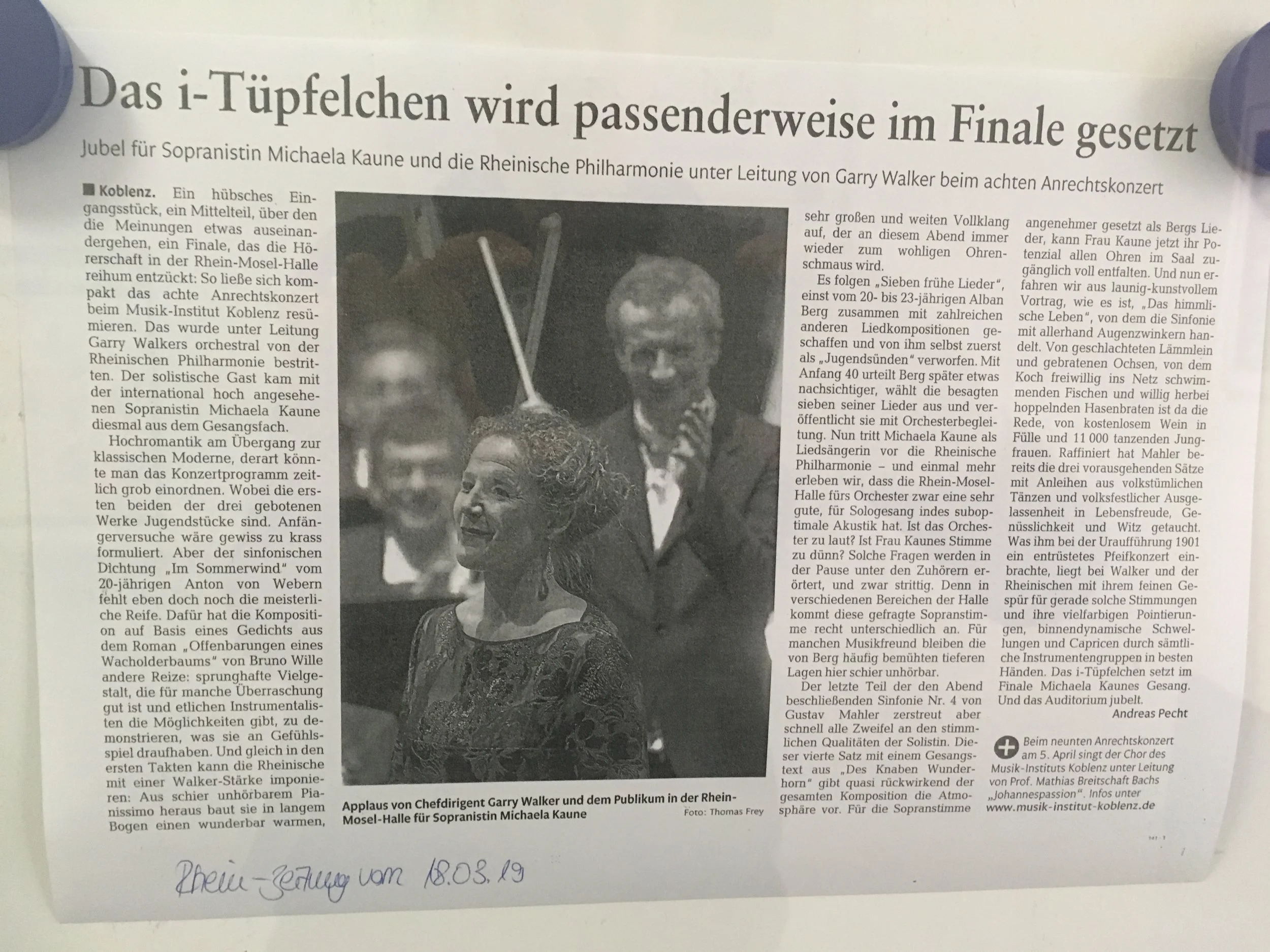
Karlsruhe Concert Crit.
Another great Crit for Opera North Schicchi/Rite of Spring double bill.
https://www.spectator.co.uk/2019/03/opera-norths-rite-of-spring-shows-the-advantages-of-confining-the-music-to-the-pit/
Gianni Schicchi crit from The Times.
Karlsruhe crit.
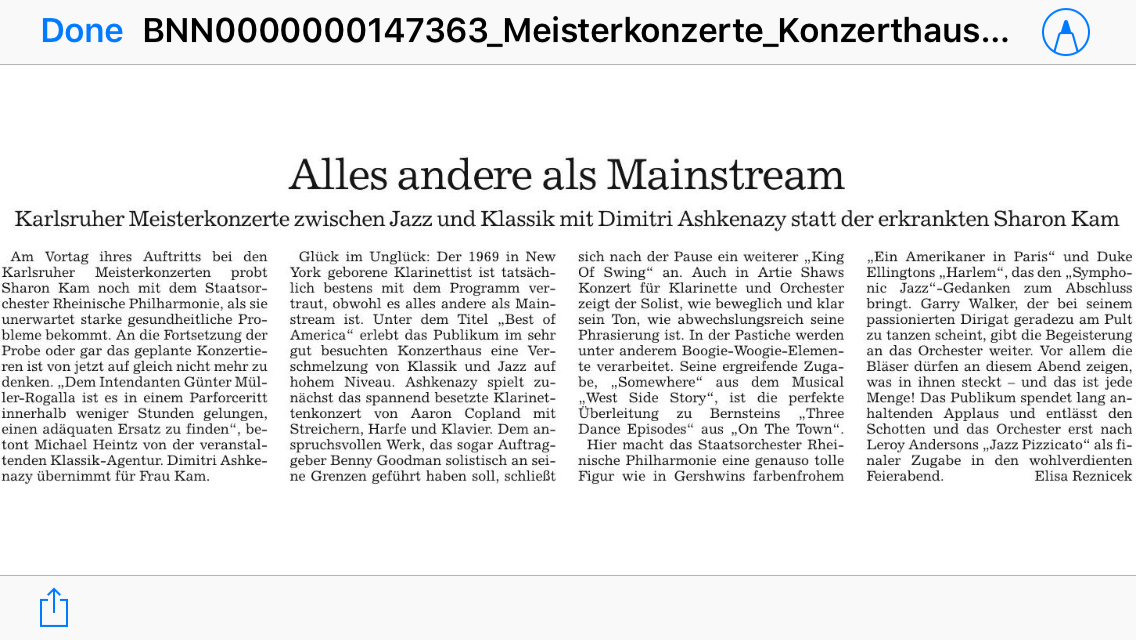
Koblenz American Project
Pretty damn good....
Ben Lomond
So rare to get to the hills at the moment. Fortunate that when I do, I get weather like this!
View across Loch Lomond to Loch Sloy and Arrocher.

Visibility was exceptional, with views to the Paps of Jura, Ben Nevis, Ben Lawers and Arran....even Ailsa Craig was clearly visible.

Because we went up quite late, we met the hoards descending, but had a reasonably quiet summit.

Ben Nevis and Glencoe in the far distance.

Looking towards Loch Tay peaks and beyond.

Descent was very much by torchlight. Was amazed to find so many people without them. Always love descending by night; all the lights along the Loch twinkling away, the moon rising...magical.
And another good crit.
Always very very fortunate to work with musicians of the quality of Alexander, Guy and the Mirglieder of the Rheinische Philharmonie

Another great crit from Koblenz; this one is a real tribute to the orchestra.

TLS Crit of The Skating Rink
Date: 20 July 2018
Page: 20
Circulation: 32166 Readership: 96498
Size (Cm2): 767
AVE: 2531.10
Display Rate: (£/cm2): 3.30
ARTS
Mythical spaces
Opera, from an organ room to an ice rink
GUY DAMMANN
Claude Debussy
PELLÉAS ET MÉLISANDE Glyndebourne Festival Opera, until August 9
David Sawer
THE SKATING RINK Garsington Festival Opera
The Glyndebourne Festival’s new pro- duction of Pelléas et Mélisande, con- ducted by Robin Ticciati and directed by Stefan Herheim, is the company’s fourth staging of the work, timed in celebration of the centenary of the composer’s death. The curtain opens, straight away, to reveal an oddly familiar space, in both senses of the term. A family and their servants are gathered in a great hall, overlooked by grand paintings and, more conspicuously, a large organ. They surround a kind of altar on which is laid the body of young woman, their apparent mourning led by Prince Golaud. In the minute and a half or so of music before the action formally begins, the com- pany dissolves, leaving Golaud, dressed in plus fours and a tweed hunting coat, lost in thought, to chance on the same young woman, equally lost and, with streaks of blood descending from her eyes down her cheeks, apparently blind, but now nonetheless living and breathing.
To a sceptical eye, much of this will seem ludicrously arch, particularly the set, which is a detailed replica of Glyndebourne’s organ room, an extension to the Elizabethan manor constructed by John Christie in the 1920s to accommodate the family’s increasingly ambitious musical life. The instrument, which looms almost preposterously large in the house (it is apparently the largest domes-
tic organ in Britain), has an even more power- ful presence on the stage, filling the entire width. This, and the way many details are crammed into the opera’s opening moments so we are equipped with the information we need to know, or to set aside, in order to understand what on earth has been done with the original scenario (in this case, “une forêt”), make for a somewhat worrying beginning. That said, Ticciati’s handling of the opening’s music is radiant, exquisitely shaded and calmly paced.
In the second scene, the rhythm of the stag- ing seems easier to grasp. The organ has shrunk to more homely proportions and the lighting acquired a more cheerful aspect, ren- dering visible the paintings as replicas of those hanging in the actual organ room next door. More important, however, is the way the movement of the singers becomes more immediately visible. This quality is particu- larly noticeable after Pelléas – dressed in a light, striped suit with a blue bow (possibly inspired by a photograph of Debussy picnick- ing) – has asked his grandfather’s permission to leave the castle to visit his dying friend. The answer is that he must wait at home because no one knows how Golaud’s return, with the mysterious princess, will affect the life of the family. The music at this point is full of dark shadows, but as the interview con- cludes it lightens until a beatific violin solo floats high above the swaying harmonies. At this moment on stage, Pelléas, his mother and
grandfather, who have been circling around each other, somehow coalesce, each leaning closely into the other, standing at an angle as if listening out for an image of beauty which might re-unite the family. The immense ten- derness of the moment, caught in arrested motion, seeps back into the gentle contours of
Copyright Newspaper Licensing Agency. For internal use only. Not for reproduction.
Date: 20 July 2018
Page: 20
Circulation: 32166 Readership: 96498
Size (Cm2): 767
AVE: 2531.10
Display Rate: (£/cm2): 3.30
the music, and yields a strange feeling of inti- macy with the usually mysterious and emo- tionally distant royal house of Allemonde.
The sense of watching a kind of pared-down ballet grows, as Golaud is welcomed back into the family and Mélisande introduced to them. The music is on tenterhooks at this stage, barely able to catch its breath, and the delicate state of relations between the characters, the balance of anxieties and tensions and the vari- ous requirements of affection and ritual, prece- dence and hospitality, are borne out in the way Herheim has the characters move in and out of each other’s orbit, as if the forces of attraction and kinship that operate between the members of this complex, taciturn but volatile family could be explained purely by the laws of gravi- tation. And indeed, the movement on stage matches perfectly the shifting focus of Debussy’s music and the way it settles, butter-
fly-like, on particular colours and motifs before being swept away by more powerful and fundamental forces; this illuminates how at its heart, Maurice Maeterlinck’s troubling and mysterious symbolist drama is basically about the tensions and paradoxes implicit in the laws of human attraction.
Another aspect, borne out in the distinction between Pelléas and Golaud, relates to ways of seeing. The two half-brothers live after all in the same castle with the same people, but they rarely see the same things. In the music, this is expressed through the contrast between the light and flowing lines of Pelléas and the dark and troubled contours of Golaud, and in the way Mélisande’s ambiguous harmonic world, though caught between the two, seems so ineluctably drawn to the former. Herheim enhances this by making Pelléas a painter, ill at ease with the feudal life of the castle but fluent in exploring its beauties. The third scene’s exploration of the kingdom becomes a tour of the organ room’s paintings, some of them works in progress, others new acquisitions brought home by Golaud on his recent journey with Mélisande. The contrast between Pel- léas’s concern with the look of things and Gol- aud’s desire to hunt and possess the objects of his awareness reaches its apex in their different
attitudes towards retrieving Mélisande’s lost ring, and in the ecstatic but all too fleeting music when the cave is illuminated with moonlight.
The soloists and orchestra are wonderfully responsive to Ticciati’s musical direction and seem entirely at one with Herheim’s under- standing of the drama. Christina Gansch gives a tremendously affecting performance as
Mélisande, while the distinction between Christopher Purves’s tortured and violent Golaud and John Chest’s ethereal Pelléas matches the framework perfectly. Brindley Sherratt’s Arkel is also affecting. Herheim’s pursuit of the logic of these characterizations can lead to odd conclusions, but the direction is always revelatory on some level, even though particular details take longer to digest than others. The action concludes, perhaps predictably, by returning to the opening funeral setting, showing the circularity of the family’s thirst for renewal. At the end, though, the characters melt away – an effect aided by Herheim and Tony Simpson’s extraordinarily dynamic lighting designs – and the room is suddenly filled with contem- porary opera-goers and tourists, keen to take in the organ room before progressing to the performance, accompanied by the luminous, peacefully lapping movements of the final bars. Again, it sounds arch, but the concern here seems to be not somehow to implicate the audience in the objectification of Mélisande so much as to illuminate how we all contribute to maintaining the mythical spaces that give life to the opera.
The mysterious laws of human attraction and gravitation are equally the subject of the Chilean novelist Roberto Bolaño’s first novel, The Skating Rink, in which a constant shifting between three narrators, and a focus on how each sees particular details in different ways, are used to gradually frame and explore the mysterious murder of Carmen, a beggar who once sang at the opera in Naples. Her body is discovered on an ice rink, built in secret with municipal funds in the swimming pool of an abandoned mansion. All of which makes it an unusual choice for operatic treatment – and yet
Copyright Newspaper Licensing Agency. For internal use only. Not for reproduction.
Date: 20 July 2018
Page: 20
Circulation: 32166 Readership: 96498
Size (Cm2): 767
AVE: 2531.10
Display Rate: (£/cm2): 3.30
somehow, in an ambitious new commission by Garsington Opera, the composer David Sawer and librettist Rory Mullarkey, together with the director and designer Stewart Laing and the conductor Garry Walker, manage to pull it off in one of the summer season’s most surprising triumphs.
Each narrator is given a single act – the drop- out poet Gaspar (Sam Furness), his smooth friend Remo (Ben Edquist) and the corrupt but still quite lovable town official Enric (Grant Dyle). The balance between narrative and action is managed superbly well, and the music fizzes with complexity, realizing its potential in a dizzying palette of styles but uniting in carefully structured rhythmic devices which seem to drive the action forward at break-neck speed – often faster than the characters would appear to be comfortable with. For a new, ambitious production, the musical standards are very high indeed. Each of the narrator-so- loists navigates the shifting between narration and interaction brilliantly, as well as capturing their contrasts in tonal colour and movement. Fine performances are also given by Susan Bickley (as Carmen), Alan Oke (as Rookie), and Lauren Zolezzio as the skater Nuria who, like Mélisande, is the object of fascination who brings together this fleeting community of nar- rators. The most surprising detail of the eve- ning, however, is that Laing’s clever, minimalist set is constructed on a kind of plas- tic which actually functions as a skating sur- face. Zolezzio – and more importantly her character-double, the skater Alice Poggio – can thereby give us a glimpse of the grace and beauty of movement that first brought the three conflicting narrators together.
Copyright Newspaper Licensing Agency. For internal use only. Not for reproduction.
Date: 20 July 2018
Page: 20
Circulation: 32166 Readership: 96498
Size (Cm2): 767
AVE: 2531.10
Display Rate: (£/cm2): 3.30
John Chest as Pelléas and Christina Gansch as Mélisande
Copyright Newspaper Licensing Agency. For internal use only. Not for reproduction.
Another good Crit.
Garsington Opera at Wormsley – The Skating Rink
Thursday, July 05, 2018 Opera Pavilion, Wormsley Park, Buckinghamshire, England
Reviewed by Alexander Campbell
Shares
A murder mystery doesn’t necessarily sound like an idea that will work, but there have been stranger inspirations for opera plots. Rory Mullarkey has adapted Roberto Bolaño’s novel skilfully. Each Act tells the same story seen from the perspective of three of the protagonists. With each repetition there are important additions as the motivations or perceptions or influences – of or on – these characters become drawn in more depth. As these facets are revealed the viewer may have to challenge some pre-conceptions.
Since there is a murder we also need to know who stabbed the mezzo-soprano and that is revealed at the end (in opera it’s never over until…). The plot revolves round the differently focussed desires of two men, Remo and Enric, for the ice-skater Nuria. When she loses her funding Enric illegally provides her with a skating rink in the basement of a disused palace, embezzling local-government funds to fund the operation. Remo desires Nuria sexually, and jealousies erupt when his boss, Enric of course, discovers their relationship. Enric is under pressure from the politically ambitious Mayor of the seaside town reliant on tourism to clear the city of vagrants. He orders Remo to enact the clearance policy, but when the night-watchman Gaspar is tasked to evict two females, the manipulative singer Carmen and her friend Caridad, he reluctantly does so but falls in love with the latter. Seeking to help her he follows her to the palace where she has sought refuge and he discovers the rink. Carmen has also discovered it and blackmails Enric with seemingly fatal consequences. She is found by Remo stabbed to death.
Within the structure imposed by the libretto David Sawer has also woven in some clever stylistic repetitions, adding a satisfying cohesiveness. The action is narrated by Gaspar, Remo and finally Enric. Musically, each one introduces themselves, but the first scene of each narrative sees them interacting with one other character who they introduce. These encounters drive the action. Sawer has created a score full of mystery and at times seeming simplicity, and the vocal lines are attractive with scope for dramatic characterisation: every word of the text is audible.
Gaspar has lyrical lines generally voiced over a cushion of cool string sound. The lady Mayor, Pilar, given a superlatively biting interpretation by Louise Winter, has very angular writing often punctuated by bursts of brass. Some of the most beautiful music is given to Enric – his Act Three scene where he dreams he can skate (marvellously realised in the staging) is full of rich lyricism. Praise to for the wonderfully vital and responsive Garsington Opera Orchestra under Garry Walker; translucent textures, rhythmic brio – especially in the jaunty dance sections. There is also great intensity when needed. Stewart Laing’s staging is also very effective. Likewise the small army of extras depicting the life of the town’s inhabitants have a fluidity of movement which is unobtrusive and realistic.
Garsington has assembled a great cast. The focus is Grant Doyle as Enric. He sings with burnished tone throughout and is dramatically effective. Ben Edquist brings a more slender tonal quality to the macho Remo and Sam Furness a honeyed intensity to Gaspar’s lines. Susan Bickley is, as ever, impressive and engaging as Carmen. She projects ferocity and menace and yet can also beguile. Alan Oke’s Rookie also provides brilliant vocal contrast in defining this drop-out character. Lauren Zolezzi is a warm-voiced and sensitive Nuria, and Claire Wild makes much of Caridad. Hats off to Garsington!
- Recorded by BBC Radio 3 for future broadcast
- Further performances on July 8, 10, 14 & 16
- www.garsingtonopera.org